
China’s U17 women’s team secured a comfortable 3-0 victory over India in the Asian Cup, clinching their spot in the World Cup. The author suggests that the goal for China’s youth teams shouldn’t be set too high—simply qualifying for the World Cup each year is a solid achievement. Playing on the global stage is the ultimate objective, as young teams cannot be judged by the same standards as senior sides.
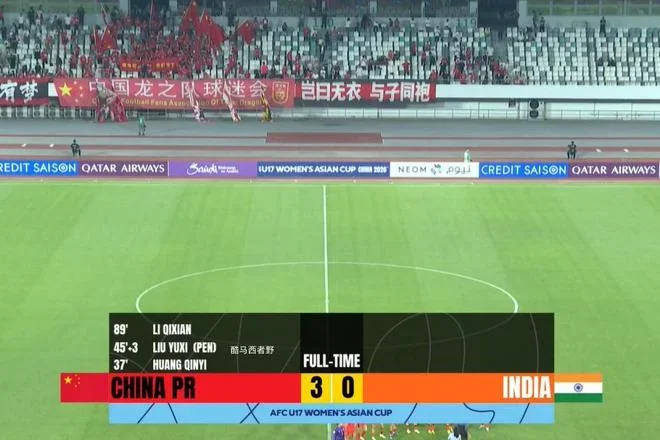
Young players in the national youth and junior teams have strong adaptability, especially those in the junior squad who still have plenty of time and space to grow. This match is part of that development process. For young athletes, technique may not be the most critical factor—mindset often determines performance on the pitch. As noted during the halftime review, the players were initially too tense. After building a two-goal lead in the first half, their mentality shifted noticeably in the second half.
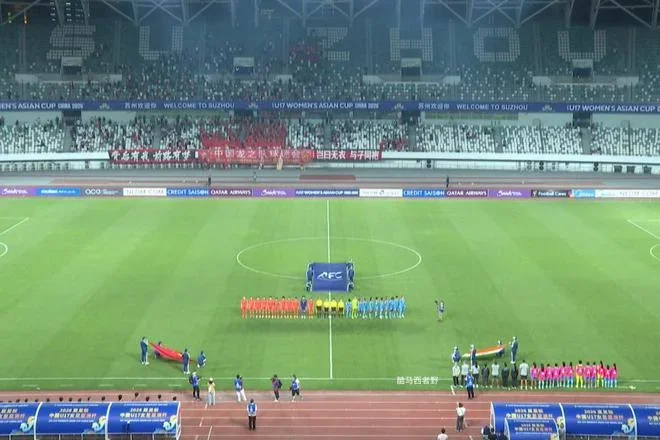
As seen in the game, India’s U17 team had a brief opportunity to score early on, but after the break, they were completely neutralized—no shots, no corners. In the first half, India managed one shot and one corner, but both numbers dropped to zero in the second half as China dominated possession. This mirrored the team’s group-stage performances.
A telling moment came around the 70th minute when forward Cheng Wandi, with her back to goal on the edge of India’s box, delivered a clever backheel pass to set up a teammate for a one-on-one chance. This demonstrated the players’ relaxed mindset at that stage—a hallmark of young players who can look entirely different under pressure versus in a calm state.
Before the match, some fans questioned whether the starting lineup was the strongest. Comparing it with the lineup from the opener against Myanmar reveals that key positions remained unchanged—this was indeed the first-choice eleven. One standout feature of this U17 squad compared to last year’s World Cup team is the remarkable balance in quality across all players. The team could use all five substitutions in every match without dropping performance levels, which is their greatest strength.
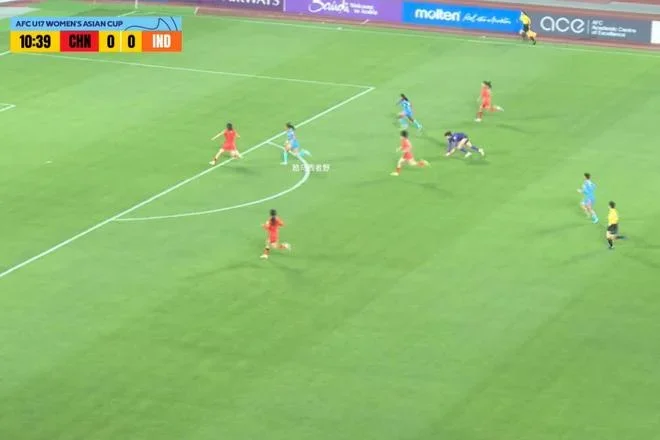
From this game, the two wingers—number 17 and number 11—played pivotal roles in the attacking setup. Repeated forays down the flanks created numerous chances. Even when number 17 was substituted in the second half, replacement number 18 maintained the same intensity. In midfield, the combinations of numbers 10, 8, 15, and 7 worked seamlessly, with each player strong enough to ensure stability throughout the full 90 minutes.
The semifinal against North Korea will be the true test. If the team manages their mindset well, it promises to be an exciting contest. This North Korean U17 side is considered the weakest in their age group in recent years.