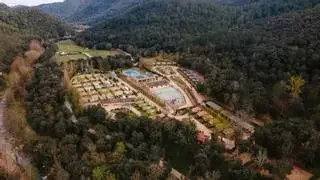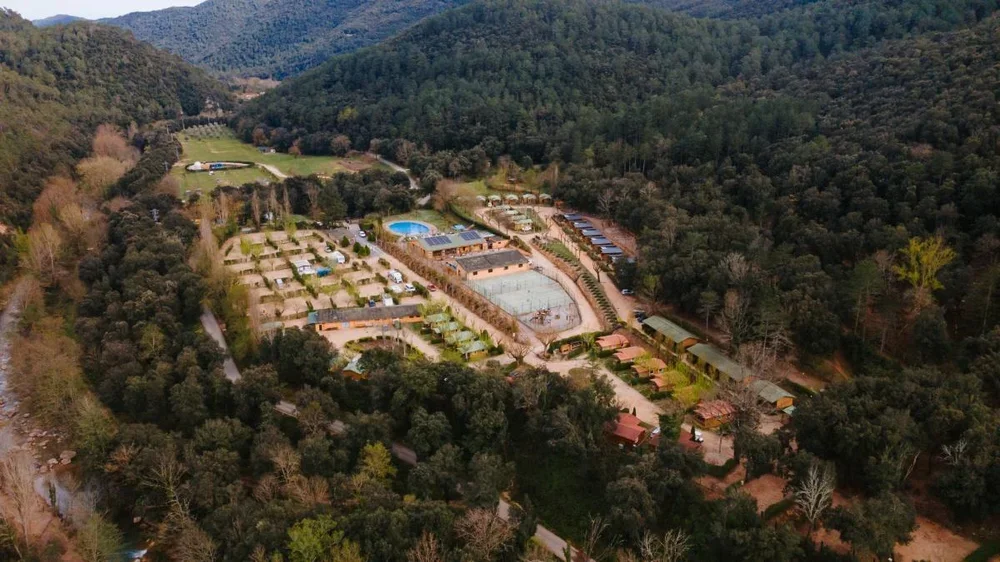
Panoramic view of TAIGA Bassegoda Park
/ VERO ZABALA

David Boti
Barcelona
In a valley in Alt Empordà, where the Muga River flows through the forests of the Catalan Pyrenees, the sky at night transforms into something most people can no longer recall seeing. No light pollution, no orange city glow, no interference. Since 2017, the International Dark-Sky Association has certified Albanyà as Spain’s first International Dark Sky Park. And in the middle of that valley, within the grounds of a campsite, sits a 40-centimeter telescope that has been helping NASA discover planets outside our solar system for years.
The Albanyà Astronomical Observatory, led by Sergio Ferrís and founded by Pere Guerra, is part of the international monitoring network for NASA’s TESS (Transiting Exoplanet Survey Satellite) mission, which is dedicated to detecting exoplanets. The satellite identifies candidates — signals of possible planets that transit in front of their star and slightly reduce its brightness. But that signal alone does not confirm anything. That’s where ground-based work comes in. “This is possible because exoplanet research today doesn’t rely solely on large professional telescopes, but on a global network of observatories carrying out key follow-up work,” explains Ferrís. The cumulative result: 22 confirmed exoplanets discovered from a valley in Girona.
The secret lies not in the telescope’s size but in the surrounding conditions. A sky near Bortle level 2 — the scale measuring darkness, where 1 is absolute darkness and 9 is the center of a large city — enables high-precision photometry, measuring tiny variations in brightness from distant stars with reliability that many urban observatories cannot achieve. In addition, the observatory is integrated into international scientific networks that coordinate observations across different points on the planet to cover as much time as possible on a single candidate.
The observatory is part of a resort campsite in Albanyà. What makes Albanyà unique is that all this science takes place in a place anyone can visit. TAIGA Bassegoda Park, the resort campsite where the observatory is located, offers what they call astronomical baptisms — accessible sessions for all audiences, no prior knowledge required, guided by Ferrís himself. Each night is different because it depends on what the sky has to offer at that moment. And what the sky offers here is a lot.
“The first time someone looks through a telescope, they often come with an idea heavily influenced by images they’ve seen online, expecting intense colors and spectacular scenes,” says Ferrís. “But what they find is different, and precisely because of that, more striking. As soon as the eye adjusts and the mind understands that this is not a photo but something truly out there, at unimaginable distances, a very powerful sensation arises. It’s a moment when many people feel a kind of inner silence, a mix of awe and calm.”
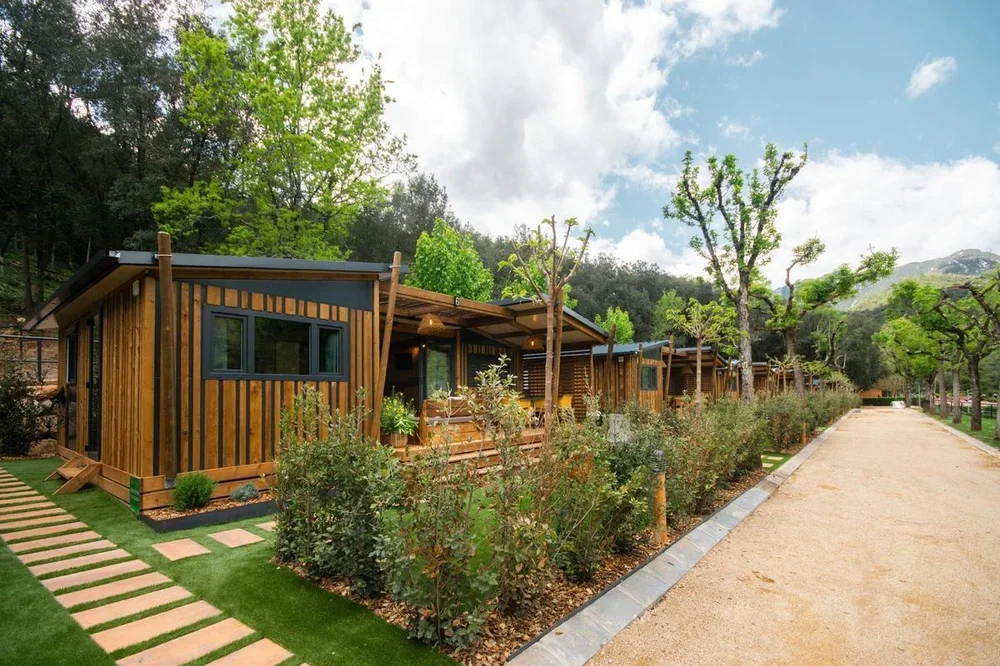
View of the interior of TAIGA Bassegoda Park with the bungalows
/ VERO ZABALA
From Albanyà, the Milky Way is visible in detailed structure — not as a diffuse band but with its dark regions and galactic arms perfectly distinguishable. Star clusters, nebulae, and even the Andromeda Galaxy can be seen with the naked eye on clear nights. The zodiacal light — that faint triangle of interplanetary dust reflecting sunlight, completely invisible in any city in the country — is also visible. And meteor showers, without the bright background that washes them out in urban skies, become something on another level.
Starfest, in July
The highlight of the year comes each July with Starfest, an astronomy festival that combines observation sessions, talks, and activities for all ages.